
Sterling Silver Jewelry Manufacturing: Hallmark Guide
A 925 stamp is a statement about alloy content, not about weight, thickness or origin. Sterling means 92.5% silver, with the balance usually copper for hardness. For buyers the practical question is narrower: can the producer repeat that mark, in the right place, on 50 pieces per design, and document the inspection that followed?

Key takeaways
- 925 means 925 parts silver per thousand; the remaining 7.5% is usually copper and is not declared by the mark.
- At 50 pieces per design, a marking error is a 50-piece problem that has to be refinished, not relabelled.
- Laser engraving survives polishing and tumbling better than a hand punch on a curved band.
- Marking sequence matters: cut before plating and the deposit can bury the stamp; cut after and bare metal shows in the groove.
What the number certifies, and what it leaves out
The stamp is a ratio. 925 means 925 parts silver per thousand, or 92.5%, with the remaining 7.5% normally copper added for hardness. Fine silver is too soft for a claw setting or a thin hoop, so the alloy is the working material, and the mark describes that alloy rather than the finished object.
Three things the stamp does not state: the weight of the piece, the thickness of any plating, and where the metal was refined. A hollow bangle and a solid bangle can both carry 925 and feel entirely different in the hand. A rhodium-plated ring and an unplated ring carry the same declaration.
That gap is where most buyer confusion begins. A customer reads 925 as a claim about the whole object. The producer reads it as a declaration about the substrate. Both readings can be honest, but the order should be clear about which one is being bought.
Verification routes differ by market. Some systems use an independent assay office, others accept a producer's mark, and a few require both. Either route holds up if the mark is applied after final polishing and if the inspection record ties each batch back to the alloy lot it came from.
Reading a set of marks in the right order
Marks come in families and mean different things. S925 and 925 both indicate sterling. A 316L stamp belongs to stainless steel and says nothing about silver. An 18KGP stamp describes gold plating over a base metal, and it can sit on a brass core or a silver one.
So a piece has to be read as a set. A silver ring stamped 18KGP is a silver ring with gold plating; a brass ring with the same plating mark is a different product at a different cost, and the two look alike in a photograph. Reading only the first mark is how buyers end up comparing the wrong two samples.
Maker's marks and country marks add a third layer. Ask which convention the order follows and who carries legal responsibility for the stamp: the factory that cut it or the brand that imported the finished goods. In private-label work the answer is usually the brand, which is why the marking clause belongs in the purchase order rather than in a design file.
Documentation helps more than vocabulary here. A one-page mark schedule — what the stamp says, which components receive it, which do not — prevents the slow drift that appears when a second production run is briefed from memory.
Placing the mark so it survives finishing
Placement is a manufacturing problem before it is a legal one. A mark cut into a shank before polishing can be flattened by the lathe. A mark cut before plating can be buried under the deposit. The sequence that holds is form, polish, mark, plate only where the mark is not covered, then inspect.
Laser engraving is the method listed for custom logos and hallmarks, with S925, 316L and 18KGP named as the mark set. A laser cuts a shallow, clean line that survives tumbling better than a hand punch, and it can follow the curve of an inner band without deforming the ring.
A 925 sterling silver jewelry manufacturer running 50 pieces per design has to repeat that placement to within a fraction of a millimetre across the batch, because a mark that wanders around the band reads as inconsistent when a customer handles two pieces side by side.
Where plating covers the mark, decide which declaration wins. Rhodium over silver hides an S925 stamp unless the mark is cut after plating, and cutting after plating leaves bare silver in the groove. Both choices are defensible on the bench; only one of them tends to be written down.
The marking specification, clause by clause
A workable spec answers five questions: which mark, where on the piece, at what depth, before or after plating, and who inspects it. The table puts those decisions in the order they occur on the bench.
| Decision | Options | Failure if left open |
|---|---|---|
| Mark content | S925, 925, brand mark only | Two conventions inside one collection |
| Position | Inner band, clasp tag, pendant reverse | Mark hidden by wear or lost in polishing |
| Method and depth | Laser engraving, stamp, cast-in | Shallow mark erased by tumbling |
| Sequence | Before or after plating | Deposit buries the mark, or the cut exposes base metal |
| Inspection | 100% visual check at final QC | Missing marks discovered by the customer |
Two rows interact. Method and sequence decide whether the mark survives at all; position decides whether anyone can read it. A cast-in mark on a pendant reverse is deep and permanent but awkward to change when a logo is redrawn. A laser mark inside a band is easy to revise and easy to polish away.
The MOQ gives the error a size. At 50 pieces per design, a marking fault is a 50-piece rework, and correcting a laser mark means refinishing the surface around it. Catching it on the first sample costs a photograph; catching it at final QC costs a week.
Buyers comparing metals in one collection can apply the same clause to custom brass jewelry, where an 18KGP mark over a brass core needs its own position and sequence. One mark schedule can cover both metals if the substrate is named in each line.
Worked example
Take a buyer opening six silver designs at the published 50-piece minimum. Six designs × 50 pieces = 300 pieces. Each piece carries one mark, and inspection covers every unit, so 300 marks are checked at final QC rather than a sample of 30 or 50.
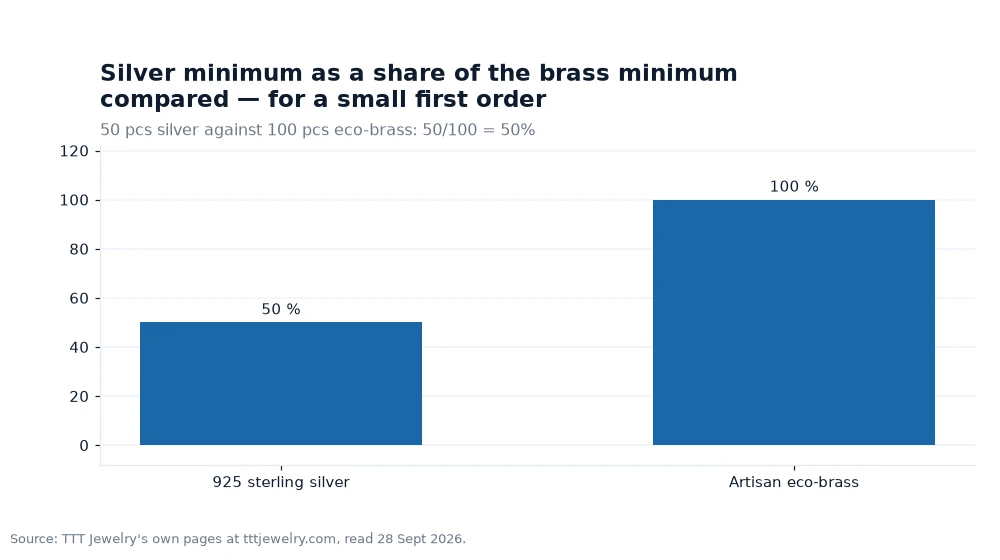
Set that against brass. The artisan eco-brass minimum is 100 pieces per design, so the same six styles would commit 6 × 100 = 600 pieces. Silver is 50 ÷ 100 = 50% of the brass threshold, which is why a first silver range can be tested on half the units and still qualify for a full production run.
The calendar does not change with the metal. CAD at under 48 hours is 2 days, sampling at 25–30 days is 3.6–4.3 weeks, and production at 3–4 weeks is 21–28 days. End to end that is 2 + 25 + 21 = 48 days at the quick end and 2 + 30 + 28 = 60 at the slow end, with 300 marks inspected somewhere inside it.
Frequently asked questions
Does a 925 stamp prove a piece is solid silver?
No. The stamp declares the alloy of the metal it is cut into, so a hollow or plated silver piece can carry the same mark as a solid one, and thickness remains a separate line in the specification.
Should the hallmark go on before or after plating?
The mark has to be legible and uncovered at the end of the process, so most orders polish first, plate with the mark area masked, and cut the mark last.
Is S925 different from 925?
The two are used interchangeably for sterling silver. The S prefix names the metal, and neither version says anything about weight, plating or origin.
Writing the clause into the purchase order
Six lines cover it: what the mark says, where it sits, how it is cut, at which stage, who inspects it, and a magnified photograph at sample approval. Every other part of a silver order can be corrected on a second run; a wrong stamp on 300 pieces travels straight to the customer.
Brands that want one supplier to carry a mark across several collections should look at how the OEM/ODM jewelry manufacturer route assigns ownership of moulds, CAD files and the finished collection, since the mark is part of that package rather than a separate favour.
Keep the approved sample with its photograph on file. It is the only evidence that survives a change of project manager, and it settles most marking disputes before they reach a customer.
Source note: figures come from the manufacturer's own website (tttjewelry.com), read 28 Sept 2026.[1]