
Auditing a Chinese Perfume Factory's Lead Times for a Subscription Run
When a factory says eight weeks, it is usually quoting the middle of a chain rather than the whole of it, and the missing links are where a subscription calendar breaks. Auditing a timeline means asking what each stage depends on, which stages can run in parallel, and which ones are triggered by a payment, an approval or a third party. The table below sets out a typical sequence for a fragrance order made in China, with the dependency and the slip point attached to each stage, so that the number a supplier quotes can be tested rather than believed.
Key takeaways
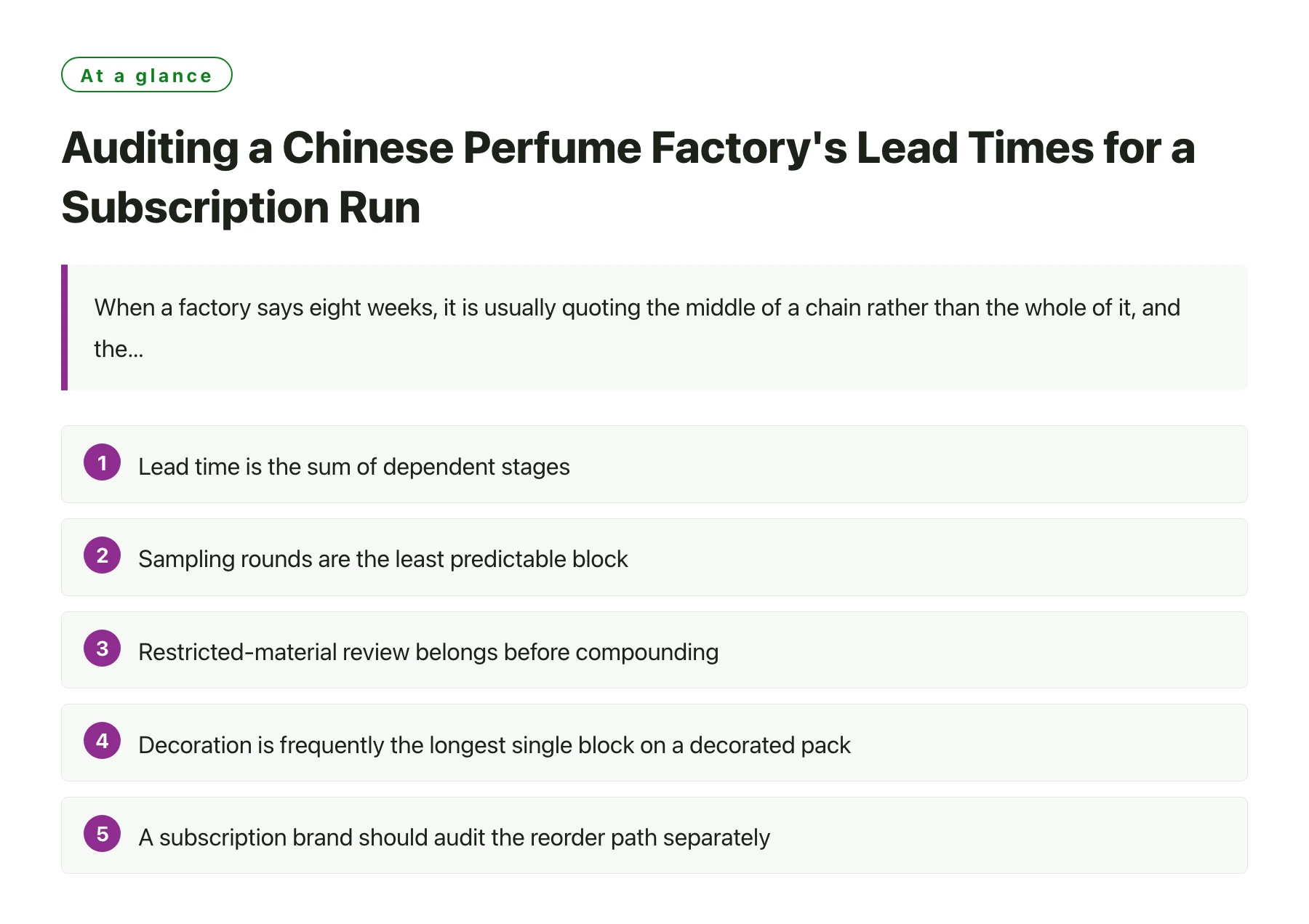
- Lead time is the sum of dependent stages, and the two that most often sit outside a factory's control are material arrival and third-party laboratory testing [1].
- Sampling rounds are the least predictable block, because each round depends on an approval decision as much as on production capacity.
- Restricted-material review belongs before compounding, not after, since a formula that fails the review has to be reworked and re-approved [2].
- Decoration is frequently the longest single block on a decorated pack, because print runs and colour approval are scheduled around other customers.
- A subscription brand should audit the reorder path separately, since the first order and the repeating order do not follow the same sequence.
- Ask for the timeline in working days with named dependencies rather than in weeks, because a week-based answer hides the holidays and approval waits inside it.
Lead time questions are usually asked at the wrong moment. They come after the sample is approved and the packaging is chosen, at which point the schedule is already largely determined and the only remaining question is how much of it can be compressed by paying more.
A subscription programme raises the stakes, because a late first order delays a launch once, while a late reorder breaks a promise that customers have already paid for. The audit below is therefore written to be done early, using the supplier's own planning language, before the order exists.
Two principles run through it. First, every stage has an owner and a trigger, and a stage without a named trigger will drift. Second, parallel work is where the real savings are, since sequential steps can only be shortened by pressure while independent steps can be shortened by planning.
The sequence, with the dependency and the slip point attached
| Stage | What it depends on | Where it slips | What to pin down before ordering |
|---|---|---|---|
| Brief and feasibility | A complete specification from the brand | A brief that is refined during the conversation rather than before it | Which fields the factory needs, and who signs the brief off |
| Development and sampling | Perfumer time plus the brand's approval decision | Waiting for feedback, and starting a new round instead of refining one | The number of rounds included and the response time expected from each side |
| Restricted-material review | The formula and the product category it will be sold in | A review completed after the scent has already been approved internally [2] | When the review happens and what the brand receives in writing |
| Packaging and decoration | Component availability, print scheduling, colour approval | Colour matching rounds and print slots shared with other customers | The decoration method, the number of approval rounds and the print slot lead time |
| Testing | Formula and pack combinations, laboratory scheduling | Tests commissioned late, or run on the wrong pack combination [1] | Which combinations are tested, by which laboratory and in what window |
| Compounding and filling | Materials, line availability, approved specification | Material arrival and line queuing at a busy period | The booking rule for line time and how a reorder is prioritised |
| Packing and shipping | Cartons, documents, transport booking | Document corrections at the port, or packing that does not match the specification | Who prepares each document and which party books transport |
Read the table as a set of questions rather than as a schedule. A supplier that answers every row specifically, and can show where its own timeline has slipped in the past, is describing a process. One that answers only in weeks is describing a hope, and a Xuelei OEM perfume manufacturer in China audit of this kind usually finishes in a single conversation.
Auditing the reorder path separately
A reorder looks like a shortened first order, but it behaves differently. Development disappears, the specification is fixed, and the critical path moves to materials, line availability and decoration slots. Those are the stages a subscription brand depends on every month, and they are the ones that a first-order quote does not describe.
What to ask about a repeating order
Ask how far ahead a reorder has to be placed to keep a preferred line slot, what the smallest sensible batch is, and whether materials for a repeat run are held or bought each time. The answers determine whether a monthly cadence is a planning commitment or an aspiration, and they are much easier to obtain before the first order than afterwards.
It is also worth asking what a realistic recovery time looks like if a batch fails a check. A supplier that can describe a rework path, and the days it adds, is giving a more useful answer than one that reports that failures never happen, which is not a process description.
Where the calendar is really won
The largest savings in a fragrance programme come from running independent work in parallel: decoration approval alongside testing, packaging sourcing alongside sampling, and document preparation alongside production. A supplier that describes its timeline as a single chain is probably running it as one, which is where a production capacity and lead times conversation becomes useful, since capacity is only a constraint once the steps have been ordered sensibly.
One question exposes more about a factory's schedule than any other: ask what it would do if the shipment had to move two weeks earlier. A supplier with a real plan will name the stages it can parallelise and the ones it cannot. A supplier without one will offer to try harder. The distinction matters most to a programme run under fragrance manufacturing under one roof conditions, where several stages share the same queue and prioritisation is a management decision rather than an accident.
Sources
- SGS: Cosmetics, Personal Care & Household Testing —— Testing, inspection and certification services for cosmetics and personal care, including microbiological, stability and safety testing aligned with cosmetics GMP.
- IFRA Standards Library (International Fragrance Association) —— The IFRA Standards Library lists the restrictions the fragrance industry applies to individual fragrance ingredients, based on safety assessments; it is the reference point for compliant fragrance formulation.
Frequently asked questions
How long does perfume production in China usually take?
A first order with development, decoration and testing commonly runs twelve to twenty weeks from brief to shipment, with sampling and decoration approval taking the largest share. A reorder is shorter, but it still depends on material availability and line scheduling, so it should be quoted separately.
Which stage slips most often?
Sample approval rounds, followed by decoration. Sampling slips when feedback takes longer than planned or when a new direction is requested instead of a refinement, and decoration slips because print slots are shared with other customers and colour approval can take several rounds.
Can lead times be shortened by paying more?
Sometimes, for specific stages such as air freight or a priority line slot. The larger gains come from planning: approving in parallel, fixing the specification before sampling and booking decoration slots early. Paying to compress a sequence that was simply ordered badly is the most expensive way to save time.
Should a subscription brand reserve capacity in advance?
It is worth asking what a reservation would involve and what it guarantees. Some factories offer a planning slot for regular volumes, others simply prioritise repeat customers informally. Either can work, but the arrangement should be written into the terms rather than assumed from a good relationship.
The messy middle is where the actual life is happening — the part no one puts on a vision board. — From the Perfectly Cursed Life editorial line
Join the Cursed Club.
One candid essay in your inbox every Sunday morning. Reader-funded, ad-free, and written for humans still figuring it out.
Join the Cursed Club — Free Newsletter